Buying land near Buckhead, GA can look simple at first glance. You see acreage, privacy, and possibilities. But in Morgan County, the real question is not just how many acres you are buying. It is whether the land can support the home, driveway, septic system, and any other improvements you have in mind. If you want to avoid expensive surprises, a little homework up front can save you a lot later. Let’s dive in.
Why land near Buckhead needs extra diligence
Buckhead and much of Morgan County are planned with a largely rural character in mind. County planning materials describe the area as heavily agricultural or agricultural-residential, with an emphasis on farming, forestry, pasture, and low-density residential uses.
For you as a buyer, that often means larger tracts and fewer lots with full utilities already in place. It also means feasibility matters more than curb appeal. A beautiful parcel is only a great purchase if it works for your intended use.
County planning also indicates that development is generally encouraged where water infrastructure already exists rather than being extended deeper into rural areas. On top of that, Morgan County is updating its 2047 Joint Comprehensive Plan, so future land-use priorities may continue to shift over time.
Start with zoning and future land use
Before you think about house plans, start by confirming the parcel’s zoning and future land-use classification. Morgan County’s Planning & Development department maintains the zoning, development, and comprehensive-plan materials, and the county directs buyers to its Public Property Record map for zoning and future land-use review.
This step matters because zoning controls what can be built and how the property can be used. In the Buckhead area, common districts include Agricultural, Agricultural Residential, Low Density Residential, and certain lakeshore-related districts and overlays.
If you assume a parcel can be split, built on, or developed a certain way without checking, you could end up with a property that does not match your goals. Older assumptions can be risky, especially since county materials note Buckhead zoning updates and ongoing planning work.
Know the minimum lot sizes
Morgan County’s zoning tables show that lot size requirements can be substantial. Agricultural dwellings generally require 5 acres, Agricultural Residential generally requires 2 acres, and Low Density Residential generally requires 1.5 acres.
If you are looking at an estate subdivision or thinking about a small development, minimums may be larger. Several residential and lakeshore districts also trigger conservation design requirements for major subdivisions.
Watch for conservation subdivision rules
If you are buying a larger tract with development potential, ask early whether conservation subdivision standards apply. Morgan County’s regulations say conservation subdivisions must preserve at least 30% open space.
They also require lot layouts that work around environmentally sensitive areas and keep buildings out of floodplain, drainage, and other hazard areas. That can affect yield, layout, costs, and the overall timeline.
Check buildability before price per acre
Land value is only part of the picture. The more important question is whether the parcel can legally and physically support your plans.
That means checking more than one issue at the same time. A site may look perfect on paper but still have limitations tied to floodplain, stream buffers, septic suitability, access, or utility service.
Floodplain and stream buffer issues
Morgan County requires a 25-foot stream buffer from perennial streams and other state waters. The county’s permit forms also ask whether a project is within 200 feet of state waters, and that can trigger extra review.
Floodplain is another key issue. According to county rules, if a property is in a floodplain, structures cannot be built until a FEMA Letter of Map Amendment is obtained. The county also notes that flood insurance can have a 30-day waiting period, which matters for both budgeting and timing.
Lakeshore rules near Lake Oconee
If you are buying a lake-area or shoreline parcel, be especially careful. In lakeshore residential and lakeshore town center overlay districts, Morgan County requires a 40-foot setback from the Georgia Power right-of-way on Lake Oconee.
That setback can directly affect where you can place a house, outdoor living areas, or other improvements. Shoreline parcels may also involve separate permits for docks and seawalls, so due diligence should include those items early.
Do not assume utilities are available
One of the biggest mistakes land buyers make is assuming utility service comes with the address. In Morgan County, current permit paperwork separates electric provider, water supply, and sewage choices by parcel, which is a strong sign that availability should be verified case by case.
In practical terms, you should confirm each service before you remove contingencies. The town name alone does not tell you what is actually available at the property line.
Water may be available, but sewer often is not
A current county staff report states that the Town of Buckhead provides water, but not sewer. That means on-site wastewater planning is still central for many parcels in and around Buckhead.
The county’s permit form reinforces this point by listing Buckhead in the water-supply section but not in the sewage options shown. If a parcel does not have sewer access, septic feasibility becomes one of the most important parts of your due diligence.
Septic should be tested early
For wastewater approvals in Morgan County, the Northeast Health District’s Environmental Health program handles septic tank permits, repair permits, existing-system evaluations, site evaluations, and subdivision plan reviews. It also states that septic and repair permit inspections are required.
This is not a step to push until after closing. If the site does not support the septic system you need, the entire project may need to change.
Access and site work can change the budget fast
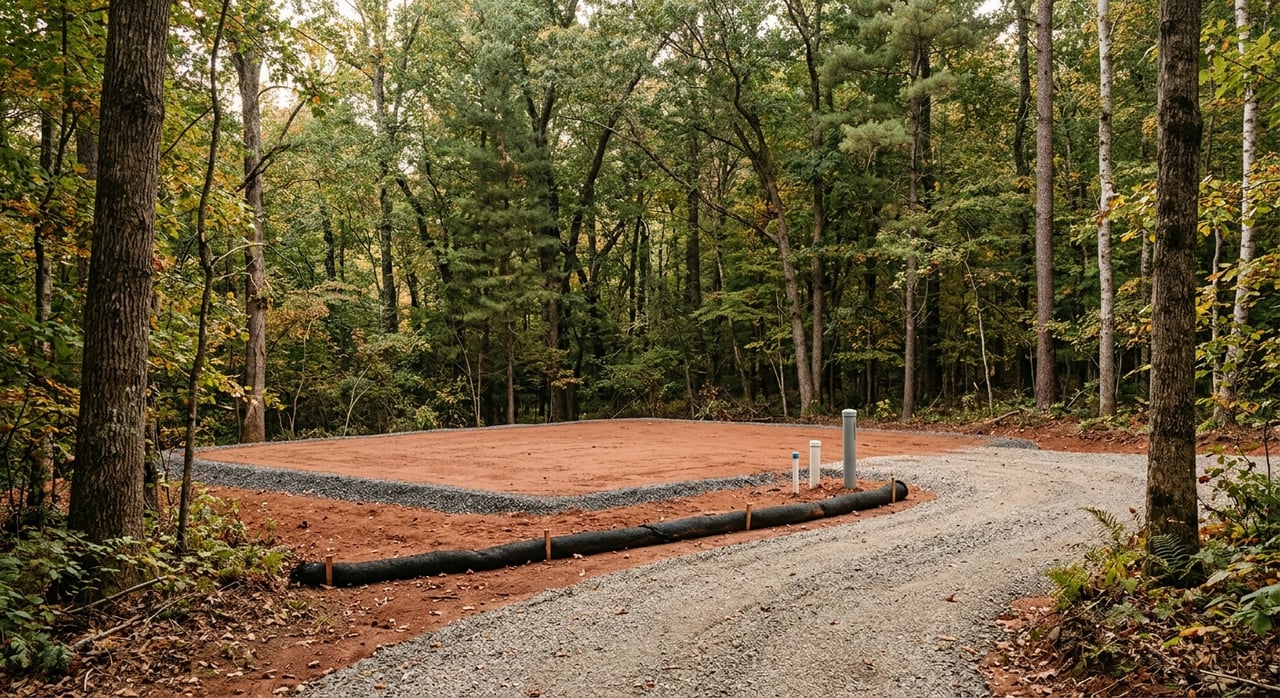
Even if the land is buildable, site work can significantly affect your total cost. Morgan County requires a site plan and site inspection for all new building permits and additions.
The county’s forms page also includes separate applications for Driveway (Roadway Access), Dock & Seawall, and Land Disturbance permits. That is a clear sign that access and improvement costs deserve detailed review before you buy.
Erosion control may need professional plans
If your project involves land disturbance over one acre, is within 200 feet of state waters, or is in certain subdivisions, Morgan County requires a professionally drawn erosion-control plan approved by the Georgia Soil and Water Conservation Commission before a permit is issued.
That can add both cost and time to your project. If you are clearing land, grading for a homesite, or planning a long driveway, this requirement should be part of your early budget conversation.
Seasonal burn rules matter too
If you expect to clear brush or prepare a site, be aware of the county’s burn-ban rules. Morgan County says there are no Georgia Forestry permits issued from May 1 through September 30, and construction materials may not be burned.
This may not stop your project, but it can affect how you plan site clearing and debris removal.
A smart due diligence checklist
Before you close on land near Buckhead, work through the basics in a careful order. This helps you avoid spending money in the wrong places or overlooking a deal-breaking issue.
Here is a practical checklist based on current county guidance:
- Confirm zoning and future land use
- Pull the tax parcel and current survey
- Verify floodplain, wetlands, and stream buffers
- Test septic feasibility
- Confirm water and electric service
- Identify needed driveway, land-disturbance, dock, or seawall permits
If you are considering a larger tract, also ask whether conservation subdivision rules, open-space requirements, rezoning, or variance steps may apply.
Build the right local team
Land purchases often need more technical review than a standard home purchase. In the Buckhead area, the right advisory team can help you spot issues early and make better decisions.
Depending on the parcel, that team should usually include:
- A surveyor
- A soil classifier or septic designer
- A civil engineer
- A local builder familiar with Morgan County requirements
- For shoreline parcels, a dock or seawall contractor
For soil research, the USDA NRCS Web Soil Survey is identified by NRCS as the official source for soils information. In practice, that gives your engineer or soil specialist a starting point to compare mapped soils with septic and foundation needs before you move forward.
Why builder-minded guidance matters
When you buy land, you are not just buying a location. You are buying a set of possibilities and constraints. That is why a builder-minded approach can be so valuable.
If you understand zoning, setbacks, site work, utilities, and septic feasibility before closing, you can make a much clearer decision about value. You can also avoid paying for land that looks appealing but is expensive or difficult to develop.
Whether you are planning a custom home, evaluating a small development opportunity, or looking at a lake-area parcel, careful due diligence is what protects your budget and timeline. If you want a practical, construction-aware perspective on land near Buckhead, Trish Byce can help you evaluate the details that matter before you commit.
FAQs
What should you verify before buying land near Buckhead, GA?
- You should confirm zoning, future land use, survey details, floodplain and stream buffer conditions, septic feasibility, utility access, and any required driveway, land-disturbance, dock, or seawall permits.
Does land near Buckhead, GA usually have sewer service?
- Not always. A current county staff report states that the Town of Buckhead provides water but not sewer, so many parcels still depend on on-site wastewater planning and septic approval.
What are common minimum lot sizes in Morgan County near Buckhead?
- Morgan County zoning tables show that Agricultural dwellings generally require 5 acres, Agricultural Residential generally requires 2 acres, and Low Density Residential generally requires 1.5 acres.
What should you know about floodplain rules for Morgan County land?
- If a property is in a floodplain, county rules say structures cannot be built until a FEMA Letter of Map Amendment is obtained, and the county also notes that flood insurance can involve a 30-day waiting period.
Are there special rules for lakefront land near Buckhead and Lake Oconee?
- Yes. In lakeshore residential and lakeshore town center overlay districts, Morgan County requires a 40-foot setback from the Georgia Power right-of-way on Lake Oconee, and shoreline improvements may also require separate dock or seawall permits.